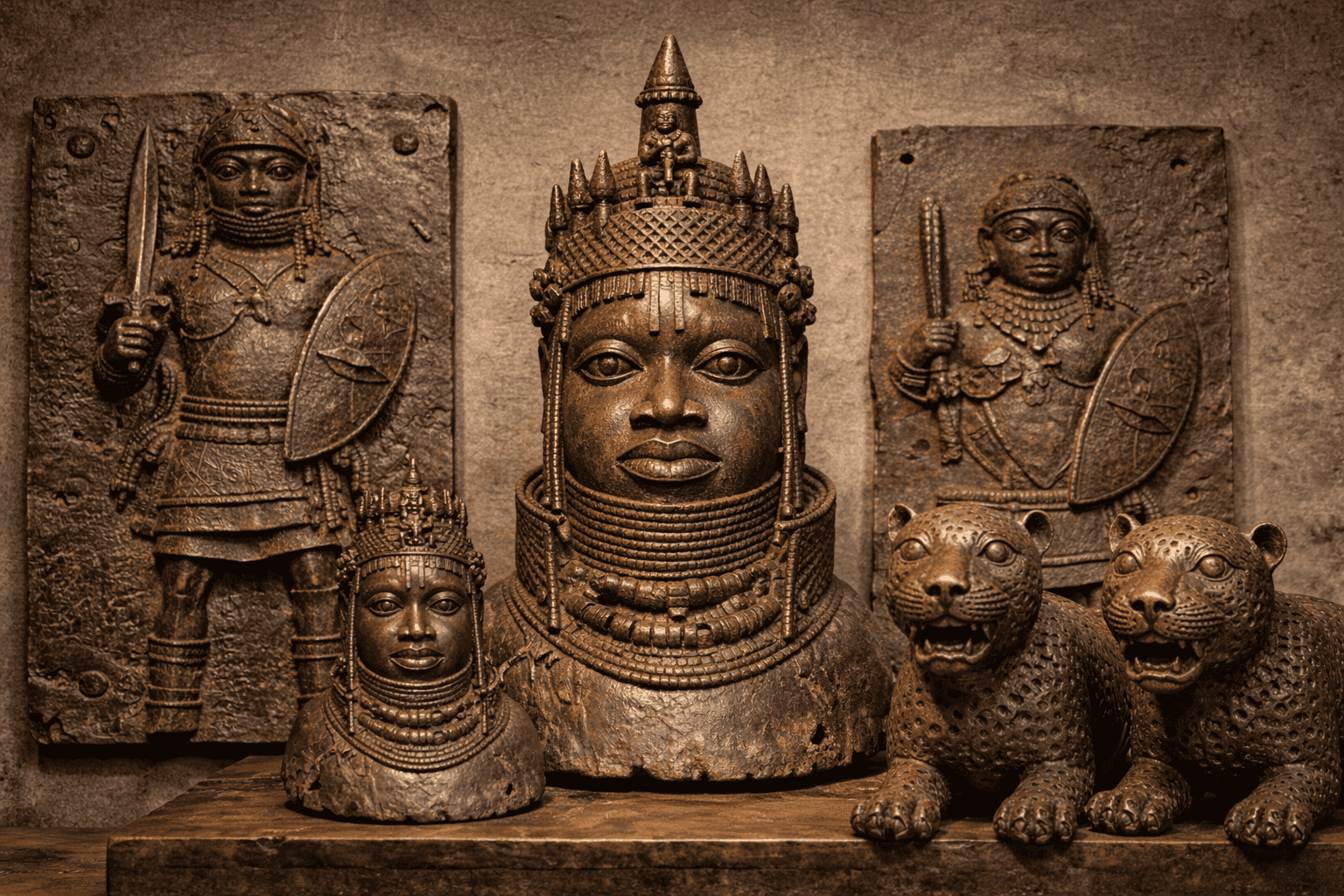
The Benin Bronzes are not actually bronze—they're mostly brass, with some made of wood, ceramic, or ivory. But whatever they're made of, these thousands of plaques and sculptures from the ancient Kingdom of Benin represent one of humanity's greatest artistic achievements.
A Kingdom of Artists
The Kingdom of Benin, located in what is now Edo State, Nigeria, was already ancient when the Portuguese arrived in the late 15th century. Its artists had been working in brass for centuries, using a sophisticated lost-wax casting technique that produced works of extraordinary detail and beauty.
The Oba (king) maintained guilds of artisans—the Igun-Eronmwon—who lived in a special quarter of the capital and whose skills were passed from father to son. These weren't just artists; they were historians, preserving the kingdom's achievements in metal.
The most famous works are the plaques that once adorned the royal palace. Each plaque tells a story: warriors in full battle regalia, Portuguese traders with their distinctive beards and hats, court officials, animals that held symbolic meaning. Together, they form a visual history of the kingdom.
The Punitive Expedition
In 1897, everything changed. British forces, seeking to expand their colonial control, launched what they called a "punitive expedition" against Benin. The city was burned, the Oba exiled, and the royal palace looted.
Approximately 3,000 to 5,000 objects were taken—not just the famous plaques, but ivory carvings, coral regalia, and ceremonial objects of immense cultural and spiritual significance. Some were sold to pay for the expedition; others ended up in museums and private collections across Europe and America.
The British soldiers and administrators who took these objects saw themselves as collectors preserving African art. They didn't understand—or didn't care—that they were tearing apart a culture's heritage.
The Fight for Repatriation
For over a century, Nigeria has sought the return of these treasures. For decades, European museums refused, arguing that they were better equipped to preserve and display the objects. But attitudes are finally changing.
In 2020, the University of Aberdeen became the first major institution to return a Benin Bronze, a cockerel sculpture that had been in its collection since 1957. Others have followed. Germany has announced plans to return hundreds of objects, and even the British Museum, which holds the largest collection, is in discussions about loans and potential returns.
The Edo Museum of West African Art, currently under construction in Benin City, will eventually house many of these returning treasures. For the first time in over a century, the Benin Bronzes will be home.
More Than Art
The Benin Bronzes are more than beautiful objects—they're the soul of a people. They contain the history, spirituality, and identity of the Edo kingdom. Their return represents not just the restitution of stolen property, but a healing of historical wounds and a recognition that Africa's cultural heritage belongs in Africa.
As the Oba of Benin, Omo N'Oba Erediauwa, has said: "Our ancestors created these works. They belong to us. They are part of who we are."