
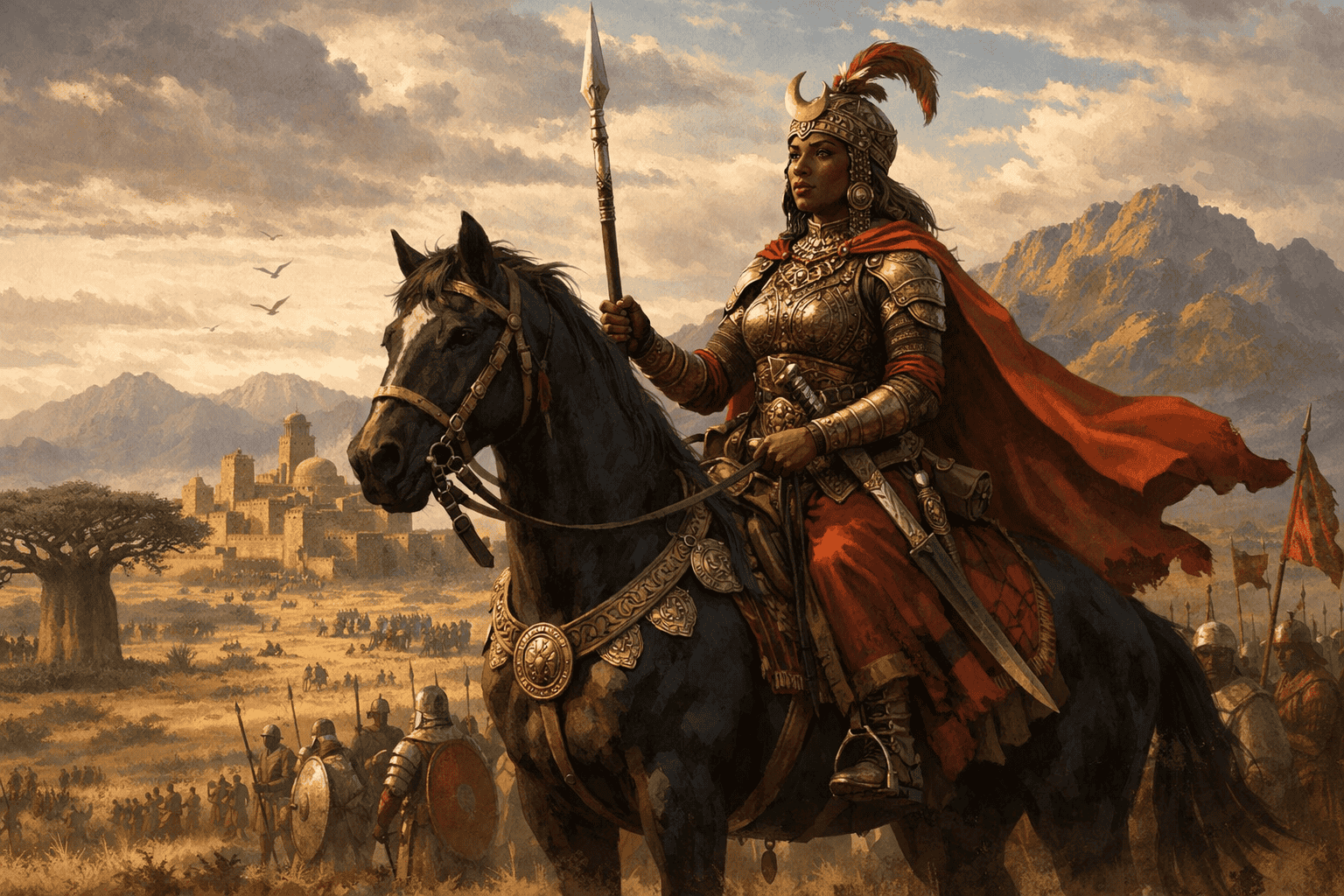
In the annals of Nigerian history, few figures loom as large as Queen Amina of Zazzau. Born into the royal family of the Hausa city-state of Zazzau (modern-day Zaria) in the early 16th century, she would grow to become one of West Africa's most legendary warrior queens.
Learning the Arts of War
Unlike many royal daughters of her time, young Amina showed little interest in the domestic arts. She preferred to watch her grandfather's warriors train, and by her teens, she had mastered horsemanship and military tactics. Her grandmother, Queen Bakwa Turunku, recognized this unusual talent and encouraged her, ensuring that Amina received the same military education as her male counterparts.
When her mother died around 1566, Amina's brother Karama became king, but she served as his chief warrior, leading campaigns that began to expand Zazzau's borders. The kingdom's prestige grew under their joint leadership.
The Warrior Queen's Reign
Upon her brother's death in 1576, Amina ascended to the throne. She immediately launched an ambitious military campaign that would last for 34 years. Her army, reportedly 20,000 strong, conquered territory after territory, eventually bringing the cities of Katsina and Kano under Zazzau's control.
What made Amina truly remarkable was not just her military prowess but her strategic vision. Every conquered territory was required to build defensive walls, or "ganuwar Amina" (Amina's walls). Many of these fortifications still stand today, silent witnesses to her empire-building genius.
The Legend of the Eunuchs
One of the most intriguing aspects of Amina's legend is her approach to marriage. She never married, reportedly taking a new lover from each conquered territory and having him killed the next morning. While historians debate the truth of this story, it reflects the fear and respect she commanded.
More verifiable is her role in transforming Kano's famous Kurmi Market. Under her influence, it grew from a local trading post into a major commercial center, connecting the trans-Saharan trade routes with the forest regions to the south.
Legacy of a Warrior Queen
Queen Amina died around 1610, but her legend only grew. Today, she is celebrated as "Amina, Yar Bakwa ta San" (Amina, daughter of Bakwa, she of the horsemen). Statues in her honor stand in Lagos and other Nigerian cities, and her story has inspired books, plays, and films.
More importantly, her reign demonstrated that women could rule and lead armies in pre-colonial Africa. In a world that often writes women out of history, Amina's story reminds us that female leadership is not a modern invention—it has deep roots in our own past.